Showing posts with label Impressions. Show all posts

Monday, July 12, 2010

Jon, Flora and the Odd-Eyed Cat by Stella Pevsner


Devyn and I love reading novels together.  Last night, we finished Jon, Flora and the Odd-Eyed Cat.

I loved reading with Devyn.  The book itself was disappointing, especially the end.

But Devyn loved it. I recall that, as we were selecting a book to read from one of our bins, she wanted to read it because she adored the cover.  She now thinks it is the most interesting story she's ever read. She especially enjoyed the variety of characters. She wishes she herself could be Flora.

I've proposed reading Mary Poppins next but Devyn would like to examine our options before agreeing.  Fair enough.

Wednesday, June 16, 2010

Review: The Breakwater House

A while back -- in December -- I won an ARC from Anansi Review Crew (House of Anansi): Pascale Quiviger's The Breakwater House.  I only just thought to check the website to see my review (February)posted and it's there.  This is how behind I am on the List of Things to Follow Up.

(It's funny because, more recently, in March, I tweeted a review to CBC (140 characters) of this book and won a copy of The Present Tense of Prinny Murphy by Jill MacLean.  This, in turn, led me to tweet a review of another book -- can't remember which -- and I won a copy of Edith's War by Andrew Smith.)

I enjoyed reviewing The Breakwater House for several reasons but I'll have to add the elaboration to my List of Things to Follow Up.

Tuesday, May 20, 2008

Kabul Beauty School (Random House, April 2007)

As often happens, I find a brilliant passage in an article that describes something far more effectively than I. In this case, the following from the New York Times captures both the co-author, Deborah Rodriquez, and the bottom-line effect of Kabul Beauty School: An American Woman Goes Behind The Veil:


The book, released April 10 [2007] by Random House, is a story of a
flame-haired, cigarette-smoking, multiply-divorced Michigan hairdresser who travels to Afghanistan, falls in love with the country, and returns later to set up a beauty school.

The story provides a greater appreciation of the cultural mores (and sometimes laws) governing male-female relationships in Afghanistan and it is this kind of ethnographic detail of both fiction and nonfiction that I generally crave.

Initially, I wanted to say that the account is kind of thin. The author could have done more to flesh out relationships, maybe focus more indepthly on the follow-up of the individual lives that she affected.

And I asked myself: What was Deborah Rodriguez's original intention in writing this book? Clearly, she wants to let the world know about the organization responsible for getting the beauty school-cum-salon off the ground.

She probably wants people to know her own difficulties in getting and keeping funding for the school which included starting a salon of her own. (In this way, she trained would-be professional beauticians, generated revenue and sourced additional teachers as the project grew.)

I like to think that she wants to convey the magnitude of the accomplishment: Empowering women with skills to run their own salons and generate income for themselves or for their families seems no small feat in a country in which women are discouraged from doing such things.

Considering the general public reaction to the book, my own observations seem inconsequential. The narrative, at times, is jagged and I wonder what, if anything, I might be missing. But I like the dialogue and the sometimes creative means by which the author overcomes language barriers.

I think she fails in some important respects. The personal stories -- when mentioned -- are not detailed enough for me. I still want to know what happened -- what really happened -- to Topekai, Baseera, Roshanna, Laila and Hama. I am still curious about Shaz.

But there are bigger problems and I may have been too optimistic in thinking that she and others might have started social reform in Afghanistan from which future generations will benefit.

According to the NPR in June 2007, the details already shared in the narrative cause controversy and anger:


the subjects of her book say Rodriguez and her newfound fame have put theirlives in danger . . .

About the subject women, the article continues:

At least one of the girls from the school has made an escape plan. One, who is called "Topekai" in the book, says her husband, who read the book, is moving their family to Pakistan.

The others — whose husbands are unaware of the
book — say they don't know what to do.

The woman called "Baseera" in Rodriguez's book says it may not matter. She is convinced someone will kill her.

This is serious and saddening: Cross-cultural value systems colliding, sociopolitical fears casting shadows over well-intentioned efforts.

And there is yet more controversy. According to quoted subjects in the New York Times (April 2007), there are questions about consistency and accuracy and perhaps enough changes to actual details that place the very nature of the narrative in question.

Frankly, like the project itself, the book initially seemed to be the start of something and, hopefully, the promise of something more. Now, I am not so certain. Did I even read a memoir?

Shades of Truth: An Account of a Kabul School Is Challenged (Abby Ellin, NYT, April 29, 2007)

Subjects of 'Kabul Beauty School' Face New Risks
(Soraya Sarhaddi Nelson, NPR, June 1, 2007)

Sunday, February 24, 2008

PostSecret

PostSecret.com is popular; its message is powerful: If secrecy alienates, then vulnerability unites.

It also attracts humans in hordes, including me.

In fact, I may have to eat my own words. I once publicly decried the rise of reality-based television as marking the end of collective reason that would have us wandering around like incoherent halfwits while civilization around us slowly declined.

Now, I see that it is the hope of glimpsing the unedited that is so compelling to an audience whether that glimpse be in a staged photograph, a carefully written celebrity interview or a tightly produced reality show. At least, that is true for me. So, when I first read a blurb about PostSecret in a magazine, I was interested.

After downloading the site, I wanted more -- much more -- so, I immediately bought the first two books: PostSecret and My Secret. At first, I was embarrassed by my interest in the lives of other people, even as I asked the clerk at my local bookstore for the copies. Then, it hit me: having secrets makes us uncomfortable because it reminds us that we're human; having access to other people's secrets makes us comfortable because it reminds us that they're human, too.

I think it is this uncensored honesty of the project's content that I found particularly moving. It also helped me with my writing. Winburn, in my weekly course readings, suggests searching for "emotional truth" in producing narrative and this now makes sense to me. The more the author gives of himself, the more willing the reader is to contribute, or to commit, to the text because he sees himself in the story.

The project also raises questions about relationships: reader and author, reader and text, author and text. Who authored this work? Certainly, the nameless public contributed the content, but did Frank Warren edit in even the slightest way? Was there purpose behind the order in which the postcards appeared? For example, was he trying to, or, did he subconsciously, elicit different emotional reactions?

My immediate impression was that there was no intention behind the sequence of secrets. The only way in which he could have removed himself from the work would have been to lay out the book without first having read the cards and, in the introduction to the book, he suggests that he did, in fact, read the secrets.

At any rate, Frank Warren seems to have achieved a significant goal of mine: He has produced a narrative that has dictated its own compositional form to the degree that this is actually possible.

______

All the books in the series are available on the website for purchase.

Wednesday, October 17, 2007

Strangers and . . . other animals?

My four-year-old has been told not to talk to strangers for a couple of years now. Lately, she has been asking just what a stranger is. Oftentimes, after speaking to an acquaintance of mine, I'll feel a tug on my shirt: "Is she a stranger?"

What a difficult question!

"Yes," I answer. "But, as long as you're with Mummy, you're safe." She cuddles closer to me.

When I received the Scholastic package that I'd ordered from her supplemental Junior Kindergarten programme last week, I looked for two titles: Never Talk To Strangers by Irma Joyce (illustrated S.D. Schindler) and Don't Talk To Strangers by Christine Mehlhaff (illustrated by Kathi Ember).

I read Never Talk To Strangers first (before the other book and before reading it to my daughter) and my first impression: lt would have been better marketed with a don't-approach-strange-animals message:

If you are hanging from a trapeze

And up sneaks a camel with bony knees,

Remember this rule, if you please --

Never talk to strangers.


I just wondered how a preschooler would abstract from the pictures of animals the idea that people are strangers and that they are dangerous (especially when some of the animals are rarely perceived as dangerous and because children of that age range have difficulty defining "stranger"). Granted, it was written in the 1960s and the author laboured under different social constraints.

Still, I had just started to read when my daughter quipped, "Hey, a giraffe isn't a stranger!"

And that's just about what I'd expected. So, the intended message is constant but lacks, well, meaningful content which makes it less of a message than a . . . slogan. I guess. (Oh, dear, that's probably another post: "Are slogans meaningful?")

Mehlhaff's Don't Talk To Strangers is much more direct and it hits all the right points about stranger safety: don't talk to strangers, don't help strangers, don't accept rides from strangers or acquaintances, etc. It even includes an Internet safety message.

Oh, yes, there are animals -- a family -- but, in this book, they're friendly and they're the main characters.

Understandably, neither book directly addresses possible consequences of disobeying the safety rules and I'm not the only mother trying to figure out how to answer the inevitable "But, why?" question. I suspect that answers are produced and nuanced by each particular parent-child relationship that engages in this dialogue. So far, for me and mine, the books' implied -- and my explicit -- answer suffices: Because it's dangerous and you could get hurt.

I do hereby swear to post interesting and meaningful links about these titles. At some point.

Sunday, September 10, 2006

The Cutting Room: Louise Welsh

In Louise Welsh’s debut novel, The Cutting Room, Rilke, an auctioneer, is an unlikely detective as he combs the streets of the underworld in which the dirty, the dark and the unseen are the norm.

While the narrator’s proclivities keep him hovering both above and below the lines of the law, his ethos is strong. We – both the audience and Rilke – discover his boundaries when he finds evidence of a gruesome crime that propels him through the underground in search of its origins.

We trudge along the streets of Glasgow, into alleys and through velvet curtains to backrooms filled with stacks of pornography. We find that the world of antiques and dealers offers a portal to another, hidden sphere in which objects of sexual fantasy throughout history have secretly collected.

Some backstories develop through Rilke’s conversations, and, for the most part, this is satisfying; however, the main character’s own history is missing. We have the impression – and, indeed, another character implies – that Rilke’s need to solve this mystery is personally motivated but the details are absent. The pace of the novel lags as these backstories develop but this seems insignificant in the overall impact of the work itself.

Secondary characters consistently reflect an awareness of the city’s dual nature and, unsurprisingly, each bears some connection to the world of crime. Imagery and actions of the underground come to the fore in vivid detail. We are chillingly reminded that crime in the world of the criminal often meets swift, brutal justice and that people are reduced to expendable resources.

Most prominently, the dialogue is comfortable: it is that of the redeemer, the gossip and the secular sinner; it illustrates the carnivalesque and the profound, the ugly and the beautiful, the criminal and the lawful, in equal measure. It lulls us into each conversation with an immediate sense of intimacy. To great effect, Welsh uses references to popular culture, poetry and stunning figurative language as she pulls us into the world of pubs, auction houses, hospitals and dimly-lit, side-street stores.

We stare unflinchingly at the unsavoury details conjured through language that is both clear and poetic, but it is a novel of immense compassion. In fact, its spiritual tone is captured in Rilke’s own words: “… there are some bad individuals, but most people do their best to be good and everybody slips up sometimes.”

In our narrator we find a credible male voice and his thoughts, appetites and character strike us with force and precision. Through him, we smell garbage and litter in alleyways and we see blood and corpses under dark, grey skies but we also hear fear in the voices of those compelled to dwell here and sense the tragedy of those who, now immobile, would rather be elsewhere.

In the end, The Cutting Room is not merely a work of crime fiction; it is also a poignant essay concerning decisions and events that push us beyond our own expectations and the power of self-acceptance.

HarperCollins Publishers Ltd.
First Canadian Edition
Trade Paper, 294 pp

Published September 10, 2006
www.bookfetish.org

Saturday, July 15, 2006

Extremely Loud & Incredibly Close: Jonathan Safran Foer

In Jonathan Safran Foer’s second novel, Extremely Loud & Incredibly Close, we find a very credible and intelligent narrator in nine-year-old Oskar Schell. We discover him—inquisitive and resourceful-- in his family’s home in New York City.

Though we are not privy to the details of the tragedy that he has suffered during September 11, 2001, we begin to see the immediate post-cataclysmic world from Oskar’s perspective. It’s a reality filled with dangerous gaping spaces left by generations, politics, histories and personal mysteries.

We learn of unspeakable realities and the need to talk about them, of trauma and coping mechanisms and the parodoxical. The author captures the discomfort felt by many who desperately needed to be around family and yet who unexpectedly embraced strangers instead. If tragedy visits questions upon us, then the answers force us to separate, at least temporarily, in order to discover how our common pain is accommodated by our individual plight.

In this light, then, we expect a novel of this emotional density to be sparse in levity but Foer manages quite a feat: he injects intense, laugh-out-loud humour right from the start and it seems to promise a smooth story.

Though its highs are high and its lows low, it isn’t, unfortunately, a rolling narrative terrain. The flow is interrupted unpredictably by other narrators who develop backstories. As impressively as the novel pivots on single events from perspective to perspective, it also jags because the narrative shifts are choppy. They hinder pace and render the unfolding of the main story altogether too sluggish.

The backstories illustrate another historical tragedy. By unflinching juxtaposition, the writer presents the horror of two particular events in vivid detail and we are spared no information that would make us uncomfortable. We are reminded that tragedy freezes us in time, creating tableaux that are released only when we have the information that we need to be able to move. Life becomes a matter of standing still, coping, and opportunities a matter of avoidance. The shadows cast by other lives dart around us, voices become invasive notes that threaten to remove hope and breathing is measured equally with tears and trepidation.

Nevertheless, reading fiction should not be labour-intensive. Questions about whether or not they belong in a novel targeted to a mature readership aside, the presence of photographs forces a continual disengagement of the reader from the text. When an author reminds us that we’re reading, he immediately places us at a distance from the imagined world, making the suspension of disbelief a matter of strife.

It is difficult to understand how a literary novel’s graphics could enhance an understanding of the work’s substance. If Mr. Foer’s illustration of the novel creates within us a sense of the alienation felt by someone who did not directly experience loss as a result of the attacks, then he succeeds. The chasm between those experiencing 9/11 and those watching the events unfold on television is unbridgeable. In the novel, we are still watching and painfully aware of this fact.

If the use of photographs, moreover, demonstrates the real-life understanding that even in our common experiences, we are separated by personal knowledge of individual circumstance, then the author, again, succeeds.

If, however, the decision represents Mr. Foer’s concern that we remember that the events of 9/11 were not imagined, it isn’t necessary and the illustrations render the flow choppy. Besides, through the use of traditional devices—the language of tragedy and a seemingly innate grasp of the machinations of a child’s mind—he keeps the horrors of that day to the fore.

In the end, it is a novel complicated by a sense that the ineffable needs to be recorded and this, too, is Jonathan Safran Foer’s success.

Trade Paper
356 pages
Mariner Books (2006)
ISBN: 0-618-71165-1

Published July 15, 2006
www.bookfetish.org

Thursday, June 01, 2006

Camilla Gibb's Sweetness In the Belly

Camilla Gibb’s most recent novel, Sweetness In The Belly, tells the story of Lilly. We discover her in London, England, but we quickly learn that her sense of self develops in Africa.

It is on this continent that she absorbs the culture and the religion of those around her in earnest—at first because she must and then because it becomes her own—and the reader falls headlong into her powerful tale.

The story develops on two continents. As it gently rocks back and forth between Ethiopia and London, we revisit eras marked by the consequences of corruption and the different faces of human pain. In the midst of poverty and alienation in Ethiopia, Lilly discovers beauty. In the midst of political tumult and upheaval in general, she discovers personal passion. We eventually learn the circumstances and details of her relationships.

It is a moving tale of romance. It is also a probing and profound exploration of the concept of personal identity. Whether derived from religious instruction, the product of a formal education or a matter of cultural identity (trying to gain acceptance or trying to escape), there are any number of ways through which we may—actively or passively--define ourselves.

The story isn’t dry. In the tiniest details, we glimpse the sound and the animation and the decay of living and, in this way, the author’s prose captures life: the sounds of sewing machines in the market, the light of a new day in a Muezzin’s call to prayer and the isolation of a sleeping city in the sounds of prowling hyenas. She even manages to convincingly trace an instance of human frailty to its ultimate cause in a long deterministic chain of events.

The author does something difficult with seeming ease: from the political, she extracts the personal; from culture-specific events, she extracts the general in human experience and we are forced to accept this one thing: movement in the world of government and organizations is not isolated to some dry, political arena. Rather, it stirs the individual. The effectiveness with which she conveys this point renders her appropriation of Lilly’s voice—a character with which the author seems to share little in common—beyond question.

Finally, she accomplishes all of this with an enviable sense of pace, language and the breathtaking realization that life can change in a single instant.

Published June 1, 2006
www.bookfetish.org

Saturday, May 06, 2006

What Ails Us?

There are many issues that affect our children. I believe that how we handle each one is critical. I can't relax about my child's welfare but I also believe that I've learned enough about raising a child to decide when an authority is necessary and when one isn't.

I'm actually not a parent who eschews the advice of parenting books. I don't think that they, The Books, make us overly paranoid or strip us of self-confidence. I also don't rush to the doctor every time there's an illness or problem. I like to think that I take a balanced, judicious approach to raising my child. Of course, I have encountered some people who avoid The Books and some who rush to the doctor always (and those who do both). I wonder how much might this be a function of our blind respect for authority.

I've just read an article about bibliotherapy by Maeve Visser Knoth in The Horn Book that challenges authority in an interesting way. She outlines her own approach to bibliotherapy as distinct from that of parents and teachers: rather than use appropriate books to guide children through difficult experiences, use them in advance of such experiences. She explains:

Rather than address what is happening in the present, I am inclined to prepare children for emotional experiences before they occur. I would rather inoculate children than treat the symptoms of the emotional trauma. We give children vaccinations against measles. We can’t vaccinate against divorce, but we can give children some emotional knowledge to use when their families, or other families they know, do go through a divorce. I advocate that we read picture books about death and divorce and new babies when no one is dying, when a marriage is strong, before anyone is pregnant.

Simply put, in contrast, traditional bibliotherapy involves matching children with characters with which they will identify. This allows a child to move through the same/similar experience(s) as that of the character, releasing emotions and gaining insight into the present problems of both himself and the character.

The author isn’t a therapist but I think that she's on to something. For those of us to whom this sounds like common sense, we must bear in mind what the author points out: parents routinely ask librarians for books in order to help a child cope with, say, the death of a loved one and teachers often "search for books that will address the emotional lives of the children in their care" as difficulties occur.

I was glad to discover this article because I'd recently made a decision that her ideas supported. I didn't need the affirmation so much as I wanted to hear someone else say that this approach only made sense.

Recently, it occurred to me once again that I should be dealing with the issue of racism because my daughter, inevitably, would be confronted with it. I struggled daily with the issue of beginning a dialogue with her on the subject. I wanted her to be forewarned and forearmed but I didn't want to frighten her or cause her to see monsters at every turn.

Some people around me offered opinions and these were divided along the single line of exactly when to begin the dialogue. Nobody argued that such communication shouldn't occur. I could discuss it before she even realized that there was a superficial difference in complexion between herself and many around her or I could wait until some racially-motivated comment or slur occurred and then discuss it with her.

Frankly, neither option seemed palatable. In the first scenario, I would have to alert her to a difference and thereby possibly cause her to think along complexion lines. In the second scenario, I would risk her one day staring blankly, hurt and confused on the playground and hope that she might bring it up with me.

This wasn't actually a dichotomy, however, since there was a third option: I could begin a discussion about peoples and cultures of the world----alerting her to the concept of difference in this respect instead of addressing head-on racism--using visual aids. (I had decided long ago that I would instruct our children--even before one existed--in matters cultural and religio-spiritual.) I could begin now, at any time, in fact, and Devyn would naturally notice differences of complexion without the need to point it out.

Turning to books only made sense and answering when to do so was easy but I was reluctant to heed my intuition. On the one hand, doing what only made sense made me nervous: maybe there was a correct way to handle the situation and I just didn't know about it? On the other hand, I felt very strongly that books-as-dialogue wouldn't be of much use once my little girl had heard the ugly language of racism, that they might just deepen raw wounds, just as Ms. Visser Knoth notes about the reading-through-experience approach:

I worry that the child who hears the story while experiencing grief will find it simplistic. What if, after thirty-two pages, the reader does not feel better? What if he feels worse? Will he feel that he has failed because Everett Anderson’s grief is now all wrapped up and the book is closed? Similarly, does the child who is living through his mother’s breast cancer treatments want to revisit them in fiction? Would he not rather escape to Narnia? I am not a therapist and don’t pretend to know.
I noted my impulse to override intuition but, inwardly, my decision was already made. I would begin using books-as-dialogue in the category of world cultures and religions beforehand and, thereby, in a natural progression, discuss prejudices, biases and the language that develops in those belief systems.

Ms. Visser Knoth states that she doesn't have teams of research to back up her approach to reading. Would teams of research even be necessary? Can’t we simply say, "Hey, this makes sense. Let's give a child tools to deal with events he's likely to encounter." Can't we, as parents, make some decisions without the benefit of expert advice? Is our struggle with the question of what to do in the face of problems complicated by a deeply-rooted sense of obedience to authority? Does our intuition--and, in this case, an intuitive approach--have to be ignored simply because it doesn't have statistical or academic sanction?

The originating article: What Ails Bibliotherapy? by Maeve Visser Knoth.

A good article as explanation of bibliotherapy.

Saturday, April 29, 2006

Notes On A Reading Experience


Last night, I introduced Charlie Parker Played Be Bop to both my child and my husband. It's one hip book. (I even provided a preamble on Thelonious Monk.)

The story was well received last night and there were requests for an encore or two.

From Horn Book:

"Raschka has created a memorable tribute to jazz great Charlie Parker in
this rhymic, syncopated, compelling, funny celebration of a man and a musical
form. The brief text sings and swings and skips along, practically of its own
volition, while the pictures add humor and just the right amount of jazziness to
the mix. One of the most innovative picture books of recent times."

It stood neglected on our shelves for a very long time. What a shame! Its time had come, I suppose.

My little girl imitated every sound that she heard and asked me to repeat some phrases.

To get a sense of the story, go here. But having the book in hand, turning pages, and returning to favourite sounds is an experience I wouldn't want to miss.

Tuesday, April 25, 2006

Madonna, My Confessions

I have to admit that I didn't think I'd ever get around to reading The English Roses by Madonna. Something about the idea repelled me: did I believe, perhaps, that this most recent self-invention of the popstar could not be much more impressive to me than her non-literary pursuits? I couldn't tell you.

I will say that I was nicely surprised. The narrative style is engrossing, the narrator engaging and the messages were, if not original, effective. (After all, how many original messages in children's literature are available to the writer?)

What impressed me was a motif about the tendency to form cliques. Madonna doesn't sugarcoat the fact that young girls can be mean; what she offers is the message that girls, if encouraged to empathize, are capable of stepping on firmer ground from which to form their beliefs. The clique doesn't disappear--because that would be an unrealistic expectation in the reader--it grows, it matures.

I love the illustrations by Jeffrey Fulvimari whose name, I note, tends to disappear in the Madonna glare. The colours are bright, feminine-looking in combination and characteristic of youthful tastes. There is also an elegance found not only in the textures (metallic adornment, striped and geometric furnishings) but also in both the figures and features of the characters: large eyes, larger-but-well-defined faces).

I will read this to my little girl when she's older (between 5 and 8 years of age). At that point, she may even read it herself.

Saturday, January 07, 2006

Indigestion

Fine. Sometimes, change is good.

Despite my earlier concerns, I find myself enjoying the new MacLean's. It truly isn't the same periodical and the maple leaf-instead-of-an-apostrophe on the front cover did signal more than a cosmetic change.

It's not stuffy and it's not tabloid. Politics and popular culture nest alongside each other if not in harmony then, at least, in a resigned state of mutual recognition.

Some might even say that the magazine has an earthy tone. In the most recent issue (Jan. 9-16), one article ("Murder by numbers") focuses on gun violence in Toronto and gun provenance in Canada, while another ("Jesus is our homey") addresses a "hip, bold take on Christianity" found in Geez magazine. In business? "Revenge of the geeks" discusses a comeback of the dot-com-ers in Ottawa. It's not news from concentrate. It's digging deeper and it's also opinion.

The new MacLean's makes me think of New York Magazine, or, at least, what I imagine New York Magazine might have been like in its earlier days of the late 1960s.

Is the new MacLean's hip? I don't know. I'm not hip.

Saturday, November 19, 2005

Notes On An Article

I have to admit that I'm addicted to magazines, especially to The Walrus and to The New Yorker. In fact, the purpose of this blog has always been to catalogue my reading for future reference, etc. but, if you'll look at my list, the nonfiction component got away from me because that is how much I read. At any rate, in an attempt to put greater effort into recording my nonfiction reading, I want to note my reaction to an article by John Lahr.

The November 14, 2005 issue of The New Yorker is worth buying just for one particular article: "The Thin Man: How Steve Buscemi Became An Indie Icon." It traces the artist from his humble beginnings to his cult-status acting. It also discusses his quiet directorial prowess.

John Lahr's gift seems to be that he can place you so intimately before his subject that, at the end, you feel as if you have been welcomed into a warm and comfortable friendship. Reaching the end of the article feels like saying goodbye to the friends with the knowledge that you probably won't see them again.

(to be continued...)

Sunday, September 11, 2005

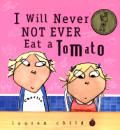
I Will Never NOT EVER Eat A Tomato

Image hosted by Photobucket.com


I love this book. The pace is rapid and the mixed-media, cut-and-paste appearance of the illustrations is imaginative and eye-catching.

Even the fonts are playful if just a little distracting to the reader.

From New York Times Book Review: "Very funny indeed."

From Publishers Weekly:

A delectable variation on the picky-eater-themed tale...Apt not to be satiated with one serving of the appetizing fare, youngsters will never--not ever--pass up a second helping.


Book Information:

Author: Lauren Child
Illustrated: Lauren Child
Publisher: Candlewick Press (2000)
Edition: First U.S.(2003)
Format: Softcover, 32 pp
Trim Size: 10.76 x 9.82 in
ISBN: 0-7636-2180-3
Reading Level: Ages 4 - 8

Illustrations: Mixed Media

Winner: Kate Greenaway Medal
Oppenheim Toy Portfolio Platinum Seal Award Winner 2001

Wednesday, August 03, 2005

Puss In Boots


Image hosted by Photobucket.com
Free Translation From the French of Charles Perrault


I was surprised to find so much information about Marcia Brown and her translation of Puss in Boots. In 1953, the book received a Caldecott Honor .

It's an ex-library copy. I have been meaning to read it this week and it has been sitting on the radiator beside my bed for ages.

If you're unfamiliar with the story, it is about a cat--bequeathed to a reluctant owner --who feels compelled to prove his worth in order to save his own skin. He, consequently, undertakes a number of tasks to this end.

The moral(s) of the story:


There is great advantage in receiving a large inheritance, but diligence and ingenuity are worth more than wealth acquired from others.

If a miller's son can win the heart of a princess in so short a time, causing her to gaze at him with lovelorn eyes, it must be due to his clothes, his appearance, and his youth. These things do play a role in matters of the heart.
(University of Pitts.)

Frankly, I have always found one of the messages disturbing: in the pursuit of one's own interests, the ends will justify the means.

The cat schemes, deceives, manipulates, intimidates--and worse--in order to render himself invaluable. He increases the worth of his owner and thereby ensures his own security.

Just one day after losing my beloved Avery, I might have waited to read it: this morning found me lying in bed, sobbing over the owner's cruel indifference and the cat's desperation.


Image hosted by Photobucket.com
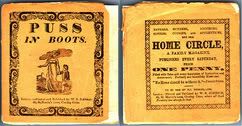
19th-cent. chapbook (University of Pittsburgh)

It is one of the stories collected by M. Perrault in Contes de ma mère l'Oye (Mother Goose Tales), c.1697*. There is an even earlier version (1630s) by Giambattista Basile in Lo cunto de li cunti overo lo trattenemiento de peccerille ("The Tale of Tales, or Entertainment for Little Ones").

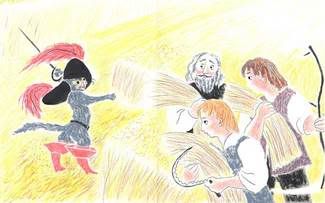
In her interpretation, Marcia Brown's style permits the reader's imagination to soar as she provides enough detail to guide without being overbearing in her construction of the cat's world. We see glimpses of landscape and blushes of expression. It is not surprising, then, that she is "noted for her spare texts, strong images and the vitality of her experimentation with a variety of media ranging from her trademark woodcuts to pen and ink and gouache." (The Horn Book).


Author: Charles Perrault
Illustrated: Marcia Brown
Format: Library Binding
Published: Charles Scribner's Sons, N.Y. (1952)
Trim Size: 27 cm x 22 cm


*The origin of the name, Mother Goose, has been a matter of dispute.

Saturday, December 11, 2004

Lola Rose

Children are resilient.

How many times have we heard this? As trite as it sounds, I know this to be true and, in this book, the author heartily assents. Fairy tales today seem to enlighten but not to frighten children; however, perhaps the sanitized versions no longer impart the kind of insight that is found in Jacqueline Wilson's Lola Rose.

The reader might well label this book an "Anti-Fairy Tale": the pre-teen narrator has many responsibilities and ugly realities with which to deal and she does so with the heartrending acceptance and grace so characteristic of abused children.

When life at home suddenly gets really frightening, Jayni, her mum and her little brother Kenny have to pack their bags and escape in the middle of the night. They also have to choose new names -- and so Jayni becomes the glamorous, grown-up Lola Rose!


As another element of instability enters Jayni's already tumultuous life, we watch a young girl as she struggles with identity, body image and the responsibilities of raising a younger sibling as well as herself. Her journey is more than that of self-discovery: it is about learning such harsh realities as injustice, dread fear and addiction in a seemingly impersonal world.

As the pressures mount at home and her mother's behaviour becomes more disappointingly predictable, Jayni cannot concentrate at school--even in her new life, everything new is old again--and she must find a way to cope that will not result in the destruction of her family unit.

For the older child, this book has so much to offer by way of illustrating certain universal conditions: the need for acceptance, peer pressures and issues of identity. Most importantly, for a child who has always worried about not having "normal" parents, this book brings comfort and reassurance.

For the child who has not had her childhood yanked away, it brings enlightenment and, probably, an appreciation of her family life as she knows it. It also aids in developing personal identity. We often define ourselves through the negative: "this" is "not me". I am confident that many readers--teenage and adult alike--will declare this throughout the book.

For the adult reader, the book is a humbling experience. In Jayni The Child we find the adult that we would like to become: insightful, strong through adversity and wise, very wise.

In the end, we want more for Jayni but she is much stronger and wiser than we: she knew all along what to expect about her circumstances; she has inhabited no fairy tale.

So, it is we who have grown. She has taught us that sometimes hope is not the strong, faithful night-light in the dark hours that we all would like; it is sometimes as brief and as fleeting as a firefly, but it can be just as stunning and powerful wherever it appears.

Don't be put off by the harsh subject matter: there is wit and humour enough to sustain even a casual reader from page to page. As trite as it sounds, trust me: you'll laugh and you'll cry and you'll want to read another Jacqueline Wilson book right away.

***


Here is The Guardian's Review